
RETATRUTIDE
Retatrutide is an investigational once-weekly peptide that targets three hormone pathways involved in appetite, blood glucose regulation and energy balance: GIP, GLP-1 and glucagon. It has produced some of the largest average weight reductions yet reported in obesity trials, but it remains unapproved in Australia.
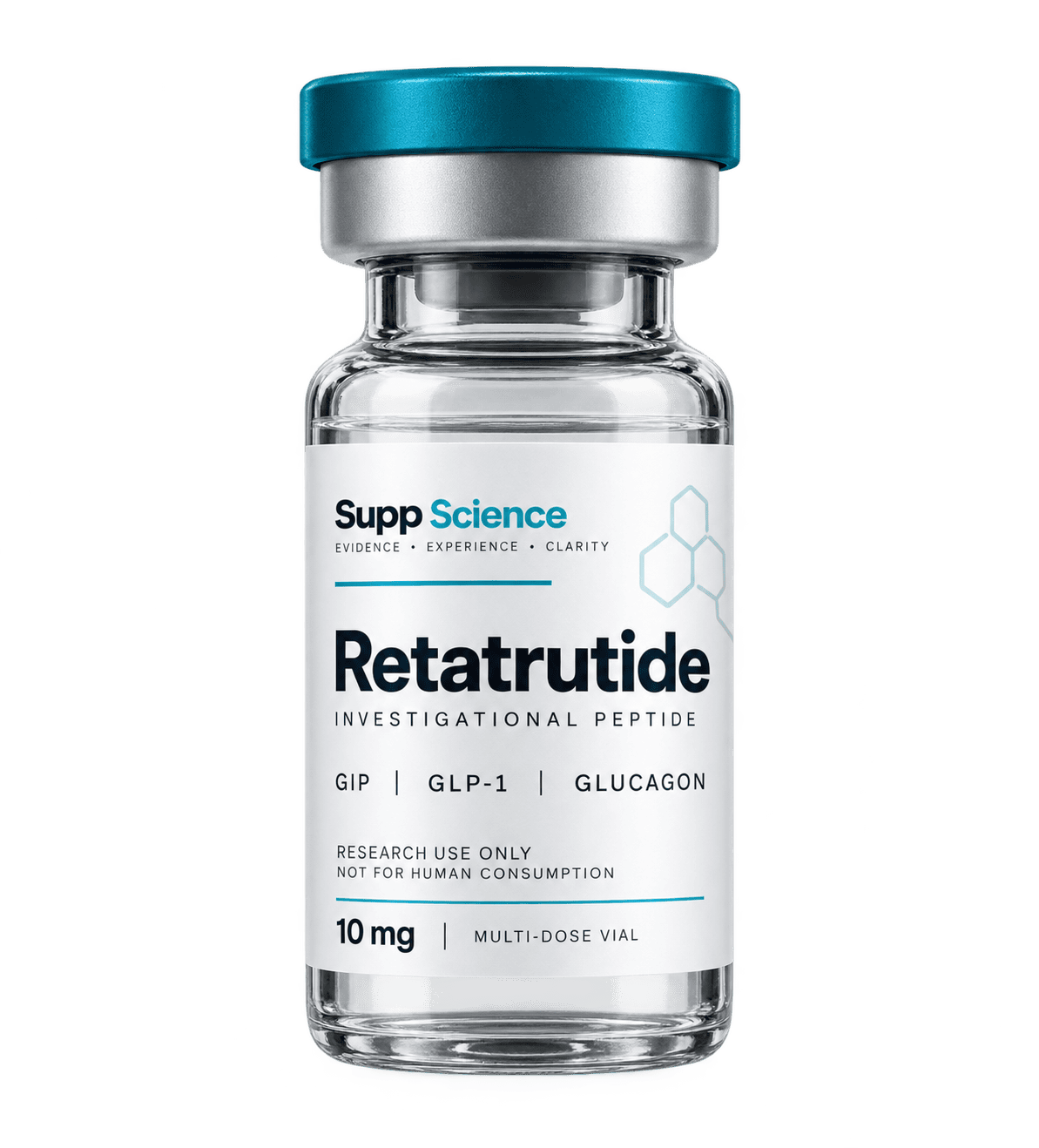
RETATRUTIDE — QUICK SUMMARY
What is Retatrutide?
Retatrutide is an investigational peptide being developed primarily for obesity and related metabolic conditions. It is designed to activate three hormone receptors at the same time: GIP, GLP-1 and glucagon.
GLP-1 and GIP are hormones released after eating and help regulate appetite, insulin secretion and how the body handles nutrients. Glucagon has a different role and can influence how stored energy is released and used. Retatrutide combines activity at all three pathways in a single molecule.
The main reason retatrutide has attracted so much attention is the amount of weight loss seen in human trials. In a peer-reviewed Phase 2 study involving 338 adults with obesity or overweight, participants assigned to the 12 mg target dose lost an average of 24.2% of their body weight over 48 weeks, compared with 2.1% with placebo.
Phase 3 results have since reported even larger reductions. In TRIUMPH-1, participants receiving 12 mg retatrutide lost an average of 28.3% of their starting body weight over 80 weeks. The average starting weight was about 112.7 kg, which corresponds to roughly 31.9 kg at the group average. Retatrutide is still investigational and is not currently an approved therapeutic product in Australia.

Retatrutide is not simply another GLP-1 drug. Semaglutide targets GLP-1, while tirzepatide targets GLP-1 and GIP. Retatrutide adds a third target — the glucagon receptor — which is the defining feature of its triple-agonist design.
Community Discussion
See what the Supp Science community is discussing about Retatrutide.
Retatrutide discussions are on the way
Community threads and discussions about Retatrutide will appear here as they are added to Supp Science.
Independent Testing
Independent laboratory results for Retatrutide commissioned by Supp Science.
No independent tests yet
We don't currently have an independent laboratory result for Retatrutide commissioned by Supp Science. You can request testing and we'll consider it for a future testing round.
Real Experiences
See how Retatrutide performs in the real world, through the experiences of people who have actually used it.
Take Part in a Supp Science Review
Apply to take part in a structured product review. Selected participants receive the product free, with their experience and results documented from start to finish.
Community Experiences
Search real experiences in people's own words.
These are individual user reports collected from third-party sources. They are presented as experiences rather than proof of cause and effect. Use the original-source link to read the surrounding discussion and context.
Retatrutide Research & Evidence
What human research tells us about weight loss, body composition, blood sugar, liver fat and the other effects being studied with Retatrutide.
Weight Loss
Weight reduction is where Retatrutide currently has its strongest human evidence.
In the published Phase 2 obesity trial, 338 adults were followed for 48 weeks. Average weight loss reached 22.8% in the 8 mg group and 24.2% in the 12 mg group, compared with 2.1% with placebo.
At 12 mg, 83% of participants lost at least 15% of their starting weight by week 48.
More recent Phase 3 results have reported even larger average reductions. In TRIUMPH-1, the 12 mg group lost an average of 28.3% over 80 weeks. Those Phase 3 findings have been publicly reported by Lilly but are newer than the peer-reviewed Phase 2 publication.
Body Fat vs Lean Mass
Large amounts of weight loss raise an obvious question: how much of the weight is actually fat?
A 2025 body-composition substudy followed 189 people with type 2 diabetes. DXA scans were used to separate fat mass from lean tissue.
At 36 weeks, average total fat mass fell by 26.1% in the pooled 8 mg group and 23.2% in the 12 mg group, compared with 4.5% with placebo.
Lean mass was also lost as body weight fell, but the proportion of lean tissue lost relative to total weight loss was similar to what has been reported with other major weight-loss treatments. The data do not suggest Retatrutide uniquely preserves all muscle.
Blood Sugar & Type 2 Diabetes
Retatrutide has also been directly studied in people with type 2 diabetes.
A Phase 2 trial enrolled 281 adults with type 2 diabetes and compared several Retatrutide doses with placebo and dulaglutide.
After 36 weeks, HbA1c — a measure of average blood glucose over the previous few months — fell by as much as approximately 2.2 percentage points. Body weight fell by as much as around 16.9%.
This shows that the effects are not limited to appetite or body weight. Retatrutide also produces substantial changes in glucose regulation in people who already have diabetes.
Liver Fat
One of the more striking secondary findings has come from people with excess fat stored in the liver.
A substudy included 98 participants from the Phase 2 obesity trial who had at least 10% liver fat at baseline. Liver fat was measured using MRI rather than estimated from routine blood tests.
After 24 weeks, liver fat had fallen by an average of 81.4% with 8 mg and 82.4% with 12 mg, compared with virtually no change with placebo.
Normal-range liver fat below 5% was reached by 79% of the 8 mg group and 86% of the 12 mg group at week 24. This is promising, but it comes from a relatively small substudy rather than a dedicated long-term liver-disease outcomes trial.
Phase 3 Results
Retatrutide has now progressed beyond the smaller Phase 2 studies into large Phase 3 trials.
In TRIUMPH-1, Lilly reported average weight loss of 28.3% with 12 mg over 80 weeks. Participants in that group lost an average of approximately 70 lb / 31.9 kg.
45.3% of participants receiving 12 mg lost at least 30% of their starting body weight.
Separate Phase 3 results in people with obesity and knee osteoarthritis have also reported average weight reductions around 29%. These results substantially strengthen the evidence base, although complete peer-reviewed publications remain more informative than company topline announcements.
Side Effects & Tolerability
The most consistent side effects in controlled trials have been gastrointestinal, particularly while doses were being increased.
In the Phase 2 obesity study, nausea occurred in 27% of Retatrutide-treated participants overall, diarrhoea in 13%, vomiting in 10% and constipation in 9%.
Phase 3 data show the same general pattern. In TRIUMPH-1, nausea was reported in up to 42% of participants receiving 12 mg, while vomiting occurred in around 25%.
Altered skin sensation, described as dysesthesia or hyperesthesia, has also appeared in trials. Heart rate increased during the earlier part of the Phase 2 study before declining later in treatment.
Retatrutide now has substantial human evidence for weight reduction, including randomised Phase 2 trials and large Phase 3 trials. Human studies also show meaningful effects on blood glucose, body fat and liver fat. The evidence is strongest for obesity and metabolic outcomes. Retatrutide remains investigational, and longer follow-up is still needed to establish long-term safety, weight maintenance and effects on major outcomes such as cardiovascular disease.
Retatrutide Questions & Answers
Yes. Weight loss is supported by controlled human trials rather than only animal research or anecdotes.
In the published Phase 2 obesity trial, people assigned to the 12 mg target dose lost an average of 24.2% of their starting body weight over 48 weeks, compared with 2.1% with placebo.
More recent Phase 3 results reported average weight loss of 28.3% over 80 weeks at 12 mg. Individual results varied considerably, so these figures are group averages rather than what every person experienced.
The main difference is the number of hormone receptors each molecule targets.
Semaglutide primarily activates the GLP-1 receptor. Tirzepatide activates GLP-1 and GIP receptors. Retatrutide activates GLP-1, GIP and glucagon receptors.
The glucagon component is what makes Retatrutide a “triple agonist.” Researchers believe it may contribute to energy use and fat metabolism, but the exact amount each individual pathway contributes to the final clinical effect cannot be separated from the current trials.
Both fat mass and lean mass decrease when large amounts of body weight are lost, but available Retatrutide data suggest most of the reduction is coming from fat.
In a Phase 2 body-composition substudy, total fat mass fell by as much as 26.1% over 36 weeks. Lean mass also declined.
Researchers concluded that the proportion of lean mass lost relative to total weight loss was similar to other obesity treatments. Retatrutide therefore should not be interpreted as specifically preserving muscle while weight falls.
Yes.
A randomised Phase 2 study included 281 adults with type 2 diabetes. Retatrutide reduced HbA1c by as much as approximately 2.2 percentage points and produced body-weight reductions of up to around 16.9% at 36 weeks.
That trial is important because it shows Retatrutide has clinically meaningful effects on glucose regulation as well as body weight.
Human research suggests it can produce very large reductions in liver fat in people who start with excess liver fat.
In a 98-person substudy, average liver fat fell by 81.4% with 8 mg and 82.4% with 12 mg after 24 weeks.
Those findings are impressive, but this was a relatively small subgroup of the larger obesity study. It does not yet establish long-term outcomes such as whether Retatrutide prevents advanced liver disease.
The most common trial side effects have been gastrointestinal: nausea, diarrhoea, vomiting and constipation.
These effects were generally more common at higher doses and during dose escalation. Phase 3 trials have also reported dysesthesia — unusual skin sensations such as increased sensitivity or tingling — in a minority of participants.
Retatrutide has also produced temporary increases in heart rate in clinical studies. Long-term safety data are still accumulating because the drug remains investigational.
Ask the Supp Science Team
Can't find what you're looking for? Send us your question and we'll look into it.
Medical Literature
Important published human research on Retatrutide, summarised in plain English.
Effects of Retatrutide on Body Composition in People with Type 2 Diabetes
This substudy included 189 participants from the Phase 2 diabetes trial and used DXA scans to measure changes in fat and lean tissue.
At 36 weeks, total body fat fell by as much as 26.1%. Lean mass also decreased, but the proportion of lean mass lost relative to total weight loss was similar to other major obesity treatments.
View Study →Triple Hormone Receptor Agonist Retatrutide for Metabolic Dysfunction-Associated Steatotic Liver Disease
This study followed 98 people from the obesity trial who had at least 10% liver fat measured by MRI.
After 24 weeks, average liver fat fell by 81.4% with 8 mg and 82.4% with 12 mg. Normal-range liver fat below 5% was reached by 79% and 86% of those groups respectively.
View Study →Triple–Hormone-Receptor Agonist Retatrutide for Obesity
This double-blind trial included 338 adults with obesity or overweight without diabetes and followed them for 48 weeks.
Average weight loss reached 24.2% in the 12 mg group and 22.8% in the 8 mg group, compared with 2.1% with placebo. Gastrointestinal side effects were the most common adverse events.
View Study →Retatrutide for People with Type 2 Diabetes
Researchers randomised 281 adults with type 2 diabetes to Retatrutide, placebo or dulaglutide and followed treatment for up to 36 weeks.
Retatrutide lowered HbA1c by as much as approximately 2.2 percentage points and reduced body weight by up to around 16.9%, showing clinically meaningful effects on both glucose regulation and weight.
View Study →LY3437943, a Novel Triple GIP, GLP-1 and Glucagon Receptor Agonist
This early multiple-dose human study established the basic pharmacology that allowed Retatrutide to move into larger trials.
Retatrutide showed dose-proportional exposure and a half-life of approximately six days, supporting once-weekly administration. The study also observed reductions in glucose and body weight, with gastrointestinal events being the most common treatment-related problems.
View Study →The published human literature is still concentrated in a relatively small number of Phase 1 and Phase 2 programmes, with several later publications analysing subgroups from those same trials. Large Phase 3 studies now provide additional evidence, but some of the newest results have initially been released through company and conference reporting rather than full peer-reviewed journal papers. Retatrutide therefore has strong evidence for short-to-medium-term weight loss, while longer-term safety and major health outcomes remain under study.
Contribute to the Evidence
Supp Science is built around independent testing, real discussion and questions from the community. Help us build a better picture of Retatrutide.