
BPC-157
BPC-157 is a synthetic 15-amino-acid peptide best known for experimental research into tissue repair, tendon healing and inflammation. Interest is high in recovery communities, but most evidence still comes from animal studies rather than controlled human trials.
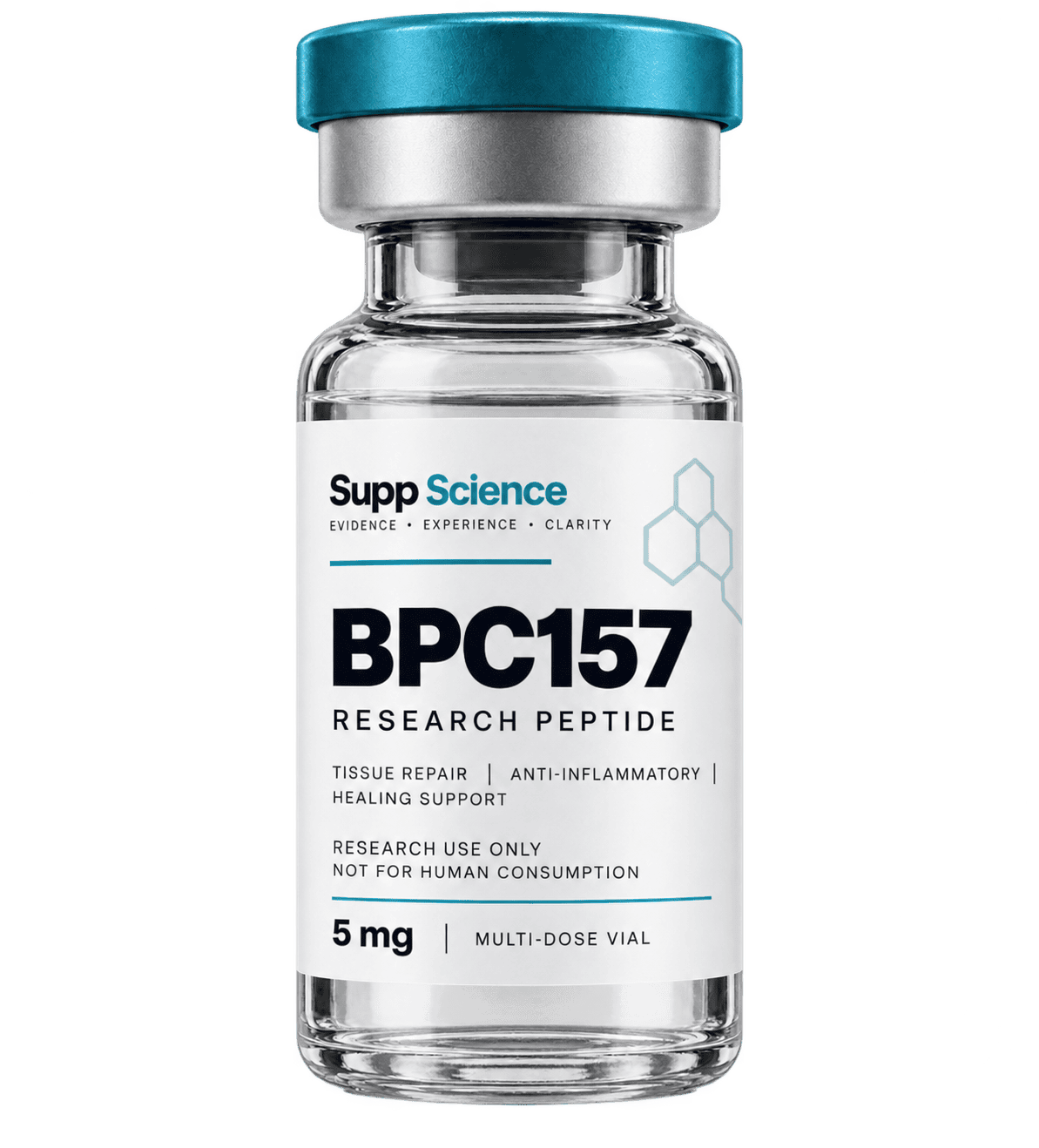
BPC-157 — QUICK SUMMARY
What is BPC-157?
BPC-157 is a synthetic peptide made from a sequence of 15 amino acids. It is commonly described as a “body protection compound” and has been investigated experimentally for effects involving tissue repair, blood-vessel formation, inflammation and healing.
Most of the interest around BPC-157 comes from animal research. Studies in rats have reported faster healing in models involving tendons, ligaments, muscles, skin and gastrointestinal tissue. Researchers have also reported changes in processes involved in collagen formation and angiogenesis — the formation of new blood vessels that help supply healing tissue.
These findings help explain why BPC-157 became popular in injury and recovery communities. However, encouraging results in animal injury models do not automatically mean the same effect occurs in people. Human research remains extremely limited compared with the amount of preclinical research.
A 2025 systematic review identified 36 studies examining BPC-157 and musculoskeletal applications, but almost all were preclinical. The review identified only a very small amount of human evidence, including a report involving 12 people with chronic knee pain. This is nowhere near the level of evidence normally required to establish whether a treatment reliably improves injury healing in humans.

BPC-157 has a surprisingly large experimental literature around healing, but most of it is animal research. Claims that it heals human tendons, ligaments or other injuries should therefore not be treated as established clinical effects. Human evidence is still very limited.
Community Discussion
See what the Supp Science community is discussing about BPC-157.
BPC-157 discussions are on the way
Community threads and discussions about BPC-157 will appear here as they are added to Supp Science.
Independent Testing
Independent laboratory results for BPC-157 commissioned by Supp Science.
No independent tests yet
We don't currently have an independent laboratory result for BPC-157 commissioned by Supp Science. You can request testing and we'll consider it for a future testing round.
Real Experiences
See how BPC-157 performs in the real world, through the experiences of people who have actually used it.
Take Part in a Supp Science Review
Apply to take part in a structured product review. Selected participants receive the product free, with their experience and results documented from start to finish.
Community Experiences
Search real experiences in people's own words.
These are individual user reports collected from third-party sources. They are presented as experiences rather than proof of cause and effect. Use the original-source link to read the surrounding discussion and context.
BPC-157 Research & Evidence
What the evidence actually tells us about injury recovery, tendon and muscle healing, pain and human safety with BPC-157.
Tendon, Ligament & Muscle Healing
This is the area most strongly associated with BPC-157, but almost all of the supporting research is still preclinical.
A 2025 systematic review identified 36 relevant studies examining BPC-157 from an orthopaedic and sports-medicine perspective. 35 were preclinical studies and only one was a human clinical study.
Animal experiments have reported improved structural, functional and biomechanical recovery after injuries involving tendons, ligaments, muscles and bone. Researchers have also reported effects on processes involved in blood-vessel formation, cell growth and inflammatory signalling.
These findings are biologically interesting, but they do not establish that BPC-157 repairs human tendons or muscles. Controlled human injury trials are still missing.
Knee Pain
The main published human musculoskeletal evidence comes from a small retrospective report involving people treated for various forms of knee pain.
The study reviewed 17 patients, with 16 available for follow-up. Twelve had received BPC-157 alone as an injection into the knee.
Of those 12 people, 11 reported significant improvement in knee pain and one reported no improvement. Four additional patients had received BPC-157 together with thymosin beta-4.
The result sounds impressive, but this was not a randomised or placebo-controlled trial. There was no standardised functional testing, imaging confirmation of healing or blinded assessment, so it cannot establish how much of the reported improvement was actually caused by BPC-157.
Bladder Pain / Interstitial Cystitis
BPC-157 has also been reported in a small human pilot study involving women with moderate-to-severe interstitial cystitis, a chronic condition involving bladder pain and urinary symptoms.
The study included 12 women aged 39–76 who had previously failed treatment with pentosan polysulfate.
After a single procedure in which BPC-157 was injected around areas of bladder inflammation, 10 of 12 participants reported complete resolution of symptoms. The other two reported roughly 80% improvement.
There was no placebo group and only 12 participants, so the study should be treated as an early clinical signal rather than strong evidence of efficacy.
Human Safety
Human safety data are exceptionally limited.
A 2025 pilot study examined intravenous BPC-157 in only two adults. Each participant received an infusion on two consecutive days while researchers monitored vital signs and blood markers relating to the heart, liver, kidneys, thyroid and glucose.
No side effects or clinically meaningful changes in the measured laboratory markers were reported.
Two people are nowhere near enough to establish a safety profile. Rare adverse effects, long-term risks, interactions and the safety of other routes remain largely unknown.
How Might It Work?
Much of the interest in BPC-157 comes from biological mechanisms observed in laboratory and animal research.
Preclinical studies have reported changes in pathways involved in angiogenesis — the formation of new blood vessels — as well as fibroblast activity, growth-factor signalling and inflammatory cytokines.
These processes matter because injured tissue needs blood supply, structural rebuilding and controlled inflammation during healing.
But a plausible healing mechanism is not the same thing as proven human recovery. The important missing step is showing that these laboratory effects translate into faster or better healing in properly controlled human trials.
The Evidence Gap
BPC-157 is unusual because its reputation among athletes and recovery communities is much larger than its clinical evidence base.
There are decades of laboratory and animal publications, but modern human research still consists mainly of very small pilot, retrospective and uncontrolled studies.
There are currently no large Phase 2 or Phase 3 trials establishing that BPC-157 improves tendon tears, muscle injuries, ligament injuries or general recovery in humans.
That gap is important when interpreting both impressive online experiences and impressive animal-study findings.
BPC-157 has an unusually large preclinical evidence base for an unapproved peptide, with repeated animal findings involving muscle, tendon, ligament, bone and other tissues. Human evidence is still extremely weak by comparison. Published clinical reports involve very small numbers of people and lack the large randomised, placebo-controlled trials needed to establish effectiveness or long-term safety.
BPC-157 Questions & Answers
There is strong evidence that BPC-157 affects healing in animal injury models, but that is not the same as showing that it heals human injuries.
A 2025 systematic review found 36 relevant musculoskeletal studies, but 35 were preclinical and only one involved human patients.
Human tendon, ligament and muscle healing therefore remains largely unproven despite the amount of experimental research.
Yes, but only in a very small number of published reports.
Human publications include a retrospective knee-pain study, a 12-person pilot study in women with interstitial cystitis and a two-person intravenous safety pilot.
These studies show that human research exists, but they are nowhere near the size or quality required to establish BPC-157 as a proven treatment.
Researchers retrospectively followed people who had received peptide injections for knee pain.
Among the 12 people who received BPC-157 alone, 11 reported significant improvement and one reported no improvement.
The major limitation is that there was no placebo group, randomisation or objective imaging showing that damaged tissue had actually healed. The study therefore reports an interesting pain outcome, not proof of regeneration.
No. There is currently far too little human data to describe BPC-157 as having an established safety profile.
A 2025 intravenous pilot study reported no side effects or meaningful laboratory abnormalities, but it involved only two people.
A study that small cannot detect uncommon adverse effects or tell us much about long-term use.
There are two main reasons: a large volume of encouraging animal research and a large number of positive anecdotal reports from athletes and people dealing with injuries.
Those two evidence streams can both be useful for identifying something worth studying, but neither replaces controlled human trials.
BPC-157's reputation has therefore advanced much faster than its formal clinical development.
Yes — but mainly as an early stage of evidence.
Animal studies help researchers identify biological effects, possible mechanisms and treatments worth taking into human trials. BPC-157 has produced unusually consistent healing-related findings across several animal injury models.
The limitation is translation: many treatments that look promising in animals eventually produce smaller effects, different effects or no meaningful benefit in people.
Ask the Supp Science Team
Can't find what you're looking for? Send us your question and we'll look into it.
Medical Literature
The limited published human research on BPC-157, plus an important review of the broader evidence base.
Safety of Intravenous Infusion of BPC157 in Humans: A Pilot Study
This extremely small study involved two adults. Researchers monitored vital signs and blood markers before and after intravenous BPC-157 infusions on two consecutive days.
Neither participant reported side effects and no meaningful changes were detected in the tested markers relating to heart, liver, kidney, thyroid or glucose function. The sample is far too small to establish general safety.
View Study →Emerging Use of BPC-157 in Orthopaedic Sports Medicine: A Systematic Review
Researchers screened the BPC-157 literature from an orthopaedic and sports-medicine perspective and included 36 studies.
The key finding for interpreting the evidence was that 35 studies were preclinical and only one was clinical. Animal studies repeatedly reported improved musculoskeletal healing, while the authors concluded that human safety and efficacy data remain inadequate.
View Study →Effect of BPC-157 on Symptoms in Patients with Interstitial Cystitis: A Pilot Study
This uncontrolled study involved 12 women aged 39–76 with moderate-to-severe interstitial cystitis who had not responded to previous medication.
Ten reported complete symptom resolution after the procedure, while two reported approximately 80% improvement. No adverse events were reported. Without a control group, the study cannot determine how much of the improvement was specifically caused by BPC-157.
View Study →Intra-Articular Injection of BPC 157 for Multiple Types of Knee Pain
A chart review identified 17 people treated for knee pain, with 16 available for follow-up. Twelve had received BPC-157 alone.
11 of those 12 reported significant improvement. However, there was no placebo group, randomisation, standardised functional outcome measure or imaging demonstrating tissue repair.
View Study →BPC-157's publication count can make the evidence base look larger than it really is clinically. Most papers are laboratory, animal or mechanistic studies. The human literature currently consists of very small uncontrolled or retrospective reports and a two-person safety pilot. There are still no large randomised trials showing that BPC-157 improves human tendon, ligament or muscle healing.
Contribute to the Evidence
Supp Science is built around independent testing, real discussion and questions from the community. Help us build a better picture of BPC-157.