
Testoterone Enanthate (Test E)

LONG-ACTING TESTOSTERONE ESTER

TESTOSTERONE
ENANTHATE

Testosterone enanthate is an injectable form of testosterone designed to release the hormone gradually after administration. It is an established prescription treatment for confirmed testosterone deficiency and is also widely discussed in strength, muscle and performance settings.
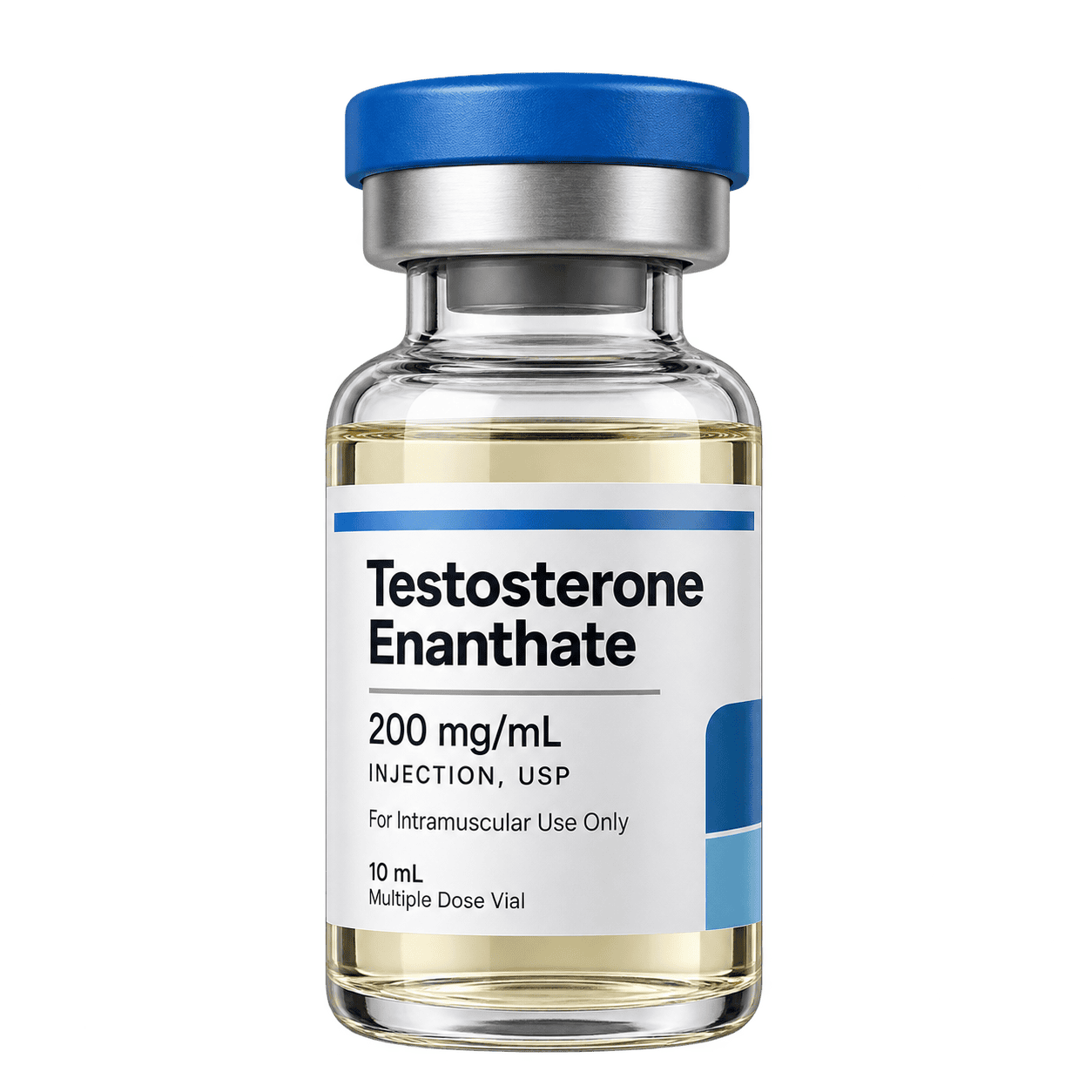
Testosterone Enanthate vial

TESTOSTERONE ENANTHATE — QUICK SUMMARY

Type Testosterone ester
Status Prescription medicine
Approved Use Testosterone replacement
Mechanism Supplies testosterone
Administration Intramuscular injection
Evidence Extensive human clinical use
01

What is Testosterone Enanthate?

Testosterone enanthate is testosterone with an enanthate ester chemically attached to it. The ester slows the release of testosterone from the injection site, allowing the hormone to remain active for longer than unmodified testosterone would.

Once released, the testosterone itself acts in the same way as the hormone naturally produced by the body. It binds to androgen receptors throughout tissues including muscle, bone, the reproductive system and the brain, influencing processes involved in sexual function, body composition, red blood cell production and maintenance of male secondary sexual characteristics.

Medically, testosterone enanthate has long been used as androgen replacement therapy in males with confirmed testosterone deficiency. Australian product information for testosterone enanthate describes it as a depot injection, meaning the oil-based preparation remains at the injection site and releases testosterone gradually over time.

Testosterone is also widely associated with muscle and strength because androgen signalling can increase muscle protein synthesis and support increases in lean mass. Human research has demonstrated these effects, particularly when testosterone levels are raised above normal physiological ranges, although that is separate from its approved medical use as replacement therapy.

Muscular man training with dumbbells in a gym
Key distinction

The enanthate ester mainly changes how testosterone is released — not what testosterone does. Once the ester is removed in the body, the active hormone is testosterone. Different testosterone esters therefore mainly differ in their release and pharmacokinetic profiles rather than acting as completely different hormones.

02

Community Discussion

See what the Supp Science community is discussing about Testosterone Enanthate.

COMING SOON

Testosterone Enanthate discussions are on the way

Community threads and discussions about Testosterone Enanthate will appear here as they are added to Supp Science.

03

Independent Testing

Independent laboratory results for Testosterone Enanthate commissioned by Supp Science.

NO RESULTS YET

No independent tests yet

We don't currently have an independent laboratory result for Testosterone Enanthate commissioned by Supp Science. You can request testing and we'll consider it for a future testing round.

Request Testing →
04

Real Experiences

See how Testosterone Enanthate performs in the real world, through the experiences of people who have actually used it.

SUPP SCIENCE REVIEW PROGRAM

Take Part in a Supp Science Review

Apply to take part in a structured product review. Selected participants receive the product free, with their experience and results documented from start to finish.

Apply for a Review →

Community Experiences

Search real experiences in people's own words.

No experiences found for this search.
i
Anecdotal experiences

These are individual user reports collected from third-party sources. They are presented as experiences rather than proof of cause and effect. Use the original-source link to read the surrounding discussion and context.

05

Testosterone Enanthate Research & Evidence

What human research tells us about testosterone replacement, muscle and strength, sexual function, body composition and the main safety changes seen during treatment.

Testosterone Replacement

Testosterone enanthate has been used for decades as a way of replacing testosterone in men whose natural levels are genuinely low.

The important distinction is that replacement therapy aims to restore testosterone towards a normal physiological range rather than deliberately create unusually high levels.

Across controlled testosterone-replacement trials, men with confirmed hypogonadism generally show small improvements in sexual desire, erectile function and sexual satisfaction compared with placebo.

Benefits are much less predictable when baseline testosterone is already normal, which is why evidence from medically hypogonadal men should not automatically be applied to healthy men.

Muscle Mass & Strength

Testosterone has clear anabolic effects in humans, meaning it can increase muscle tissue and support greater strength.

In a landmark controlled trial, 43 healthy men received either placebo or 600 mg of testosterone enanthate weekly for 10 weeks, with or without resistance training.

Testosterone increased muscle size and strength even without exercise. The combination of testosterone and resistance training produced the largest increases.

This study used a deliberately supraphysiological dose and therefore demonstrates testosterone's anabolic potential rather than representing ordinary replacement therapy.

Dose-Response

Human research shows that several effects of testosterone become larger as circulating testosterone concentrations rise.

In a 20-week trial, 61 healthy men aged 18–35 had their natural testosterone suppressed and then received weekly testosterone enanthate doses ranging from 25 mg to 600 mg.

Fat-free mass increased by about 3.4 kg in the 125 mg group, 5.2 kg in the 300 mg group and 7.9 kg in the 600 mg group.

Leg strength, muscle size, haemoglobin and IGF-1 also increased with testosterone exposure, while fat mass generally moved in the opposite direction.

Sexual Function

Sexual symptoms are one of the main reasons testosterone replacement is prescribed to men with confirmed deficiency.

A systematic review of placebo-controlled trials involving 1,779 hypogonadal men found small average improvements in libido, erectile function and sexual satisfaction with testosterone therapy.

The effect is not universal. Larger reviews show that erectile function in particular may improve only modestly, and response tends to be more apparent in men who begin with genuinely low testosterone.

Testosterone therefore should not be viewed as a guaranteed treatment for erectile dysfunction, which can have many causes unrelated to testosterone.

Body Composition & Physical Function

Replacement-level testosterone has also been studied over much longer periods in older men with low testosterone.

In one three-year trial, 70 men aged 65 or older with testosterone below 350 ng/dL received testosterone enanthate, testosterone plus finasteride, or placebo.

Testosterone increased lean body mass by around 3.7 kg, while the placebo group changed by about -0.2 kg. Physical performance and grip strength also improved.

These results show that medically restoring testosterone can improve body composition in deficient older men without requiring the extreme hormone levels used in some performance studies.

!

Haematocrit & Blood Changes

One of the clearest measurable safety effects of testosterone is an increase in red blood cell production.

In controlled dose-response research involving 121 younger and older men, haemoglobin and haematocrit increased progressively as testosterone exposure increased.

The effect was stronger in older men. A separate meta-analysis of testosterone-replacement trials found that testosterone significantly increased the risk of erythrocytosis — an abnormally high concentration of red blood cells.

This is one reason blood monitoring is an important part of medically supervised testosterone treatment.

Evidence strength

Testosterone has an extensive human evidence base. Testosterone enanthate itself has been studied in controlled trials ranging from medical replacement in men with low testosterone to experimental supraphysiological dosing in healthy men. Evidence is strong that testosterone affects lean mass, strength, sexual function and red blood cell production, but the size and relevance of these effects depend heavily on baseline testosterone levels and the amount of testosterone exposure.

06

Testosterone Enanthate Questions & Answers

Enanthate is an ester attached to the testosterone molecule. Its main purpose is to slow how quickly testosterone leaves the injection site and enters circulation.

Once the ester is removed in the body, the active hormone is testosterone. The ester mainly changes the release profile rather than creating a completely different hormone.

Was this helpful?

The active testosterone released from testosterone enanthate is the same testosterone hormone that naturally circulates in the body.

The difference is the attached enanthate ester, which allows an injected depot of testosterone to release gradually rather than disappearing from circulation very quickly.

Was this helpful?

Yes. This is one of the clearest findings in the human testosterone literature.

Controlled trials show increases in fat-free mass, muscle size, strength and power as testosterone exposure rises. In a 20-week dose-response study, men receiving the highest experimental dose gained around 7.9 kg of fat-free mass.

That result came from supraphysiological research and should not be interpreted as the expected result from medical testosterone replacement.

Was this helpful?

No.

Testosterone therapy tends to improve sexual desire most consistently in men who genuinely have low testosterone. Improvements in erectile function are generally smaller and less predictable.

Erectile function is influenced by blood vessels, nerves, medications, psychological factors and other health conditions, so restoring testosterone does not automatically correct every cause of erectile dysfunction.

Was this helpful?

Testosterone stimulates the body to produce more red blood cells.

Human dose-response studies show that haemoglobin and haematocrit rise as testosterone exposure increases, with a stronger response seen in older men.

When the concentration rises too far it is called erythrocytosis, which is why haematocrit is commonly monitored during medically supervised testosterone treatment.

Was this helpful?

No. They answer different questions.

Testosterone replacement trials usually study men with low testosterone and aim to restore hormone levels towards a normal physiological range.

Performance studies have also deliberately used much larger amounts to create testosterone concentrations above the normal range. Those studies are useful for understanding anabolic dose-response effects, but their results and risks should not be treated as equivalent to medically supervised replacement.

Was this helpful?
?
HAVE A QUESTION?

Ask the Supp Science Team

Can't find what you're looking for? Send us your question and we'll look into it.

Ask a Question →
07

Medical Literature

Important human research on testosterone enanthate and testosterone replacement, summarised in plain English.

SYSTEMATIC REVIEW 2025

Testosterone Replacement in Men with Sexual Dysfunction

This Cochrane-derived review included 43 randomised studies involving 11,419 men.

Across the available trials, testosterone produced little to modest average changes in erectile function and sexual quality of life. The findings reinforce that testosterone is not a universal treatment for sexual dysfunction.

View Study →
SYSTEMATIC REVIEW & META-ANALYSIS 2018

Efficacy and Adverse Events of Testosterone Replacement Therapy in Hypogonadal Men

Researchers analysed four high-quality placebo-controlled trials involving 1,779 men with confirmed hypogonadism.

Testosterone produced small improvements in libido, erectile function and sexual satisfaction, but did not significantly improve energy or mood. It also substantially increased the relative risk of erythrocytosis.

View Study →
HUMAN DOSE-RESPONSE STUDY 2010

Testosterone Dose and Conversion to Estradiol and Dihydrotestosterone

Researchers studied 51 younger and 52 older men receiving graded testosterone enanthate doses after suppression of their own testosterone production.

Estradiol and dihydrotestosterone increased as testosterone exposure increased. The study demonstrates that administered testosterone is converted into other biologically active hormones as well as acting directly through androgen receptors.

View Study →
RANDOMISED CONTROLLED TRIAL 2008

Effect of Testosterone Therapy on Bone Mineral Density in Elderly Men

This double-blind trial included 48 men over 60 with low testosterone. Twenty-five received intramuscular testosterone enanthate and 23 received placebo for 12 months.

Researchers measured bone mineral density at the lumbar spine and hip to determine whether restoring testosterone influenced skeletal health in older men with low hormone levels.

View Study →
HUMAN DOSE-RESPONSE STUDY 2008

Effects of Graded Testosterone Doses on Red Blood Cell Production

This analysis involved 121 men — 61 younger and 60 older — receiving graded doses of testosterone enanthate for 20 weeks.

Haemoglobin and haematocrit increased in a clear dose-dependent fashion. Older men experienced larger increases than younger men, helping explain why erythrocytosis is an important monitoring issue during testosterone treatment.

View Study →
RANDOMISED CONTROLLED TRIAL 2005

Testosterone Enanthate and Physical Function in Older Men with Low Testosterone

70 men aged 65 or older with testosterone below 350 ng/dL were randomised to testosterone enanthate, testosterone plus finasteride, or placebo for three years.

Testosterone increased lean body mass by around 3.7 kg, compared with essentially no change with placebo. Physical performance and grip strength also improved.

View Study →
RANDOMISED DOSE-RESPONSE TRIAL 2001

Testosterone Dose-Response Relationships in Healthy Young Men

61 healthy men aged 18–35 had their natural testosterone suppressed and then received one of five weekly testosterone enanthate doses for 20 weeks.

Fat-free mass rose by about 3.4 kg, 5.2 kg and 7.9 kg in the 125 mg, 300 mg and 600 mg groups, respectively. Strength, muscle size and haemoglobin also increased with testosterone exposure.

View Study →
RANDOMISED PLACEBO-CONTROLLED TRIAL 2001

Testosterone Replacement in Hypogonadal Men with Major Depression

Thirty men with major depressive disorder and low testosterone were randomised to weekly testosterone enanthate or placebo for six weeks.

Testosterone successfully restored hormone levels, but depression scores improved similarly in both groups. The trial is a useful reminder that correcting testosterone does not automatically improve every symptom associated with low mood or fatigue.

View Study →
RANDOMISED CONTROLLED TRIAL 1996

Effects of Supraphysiologic Testosterone on Muscle Size and Strength

This landmark trial randomised 43 healthy men to placebo or testosterone enanthate, with or without resistance exercise, for 10 weeks.

Testosterone increased muscle size and strength independently of training, while combining testosterone with resistance exercise produced the largest changes. The dose deliberately created supraphysiological testosterone levels and was not a replacement therapy study.

View Study →
i
Reading the evidence

Testosterone research spans very different populations and hormone exposures. Medical replacement studies usually involve men with confirmed low testosterone and aim to restore physiological levels, while several important muscle and dose-response studies deliberately created concentrations above the normal range. Results from these two settings answer different questions and should not be treated as interchangeable.