SEMAX
Semax is a nootropic and neuroprotective peptide originally developed in Russia. Research has explored its effects on memory, attention and neurological recovery, with particular interest in its influence on brain plasticity and BDNF signalling.
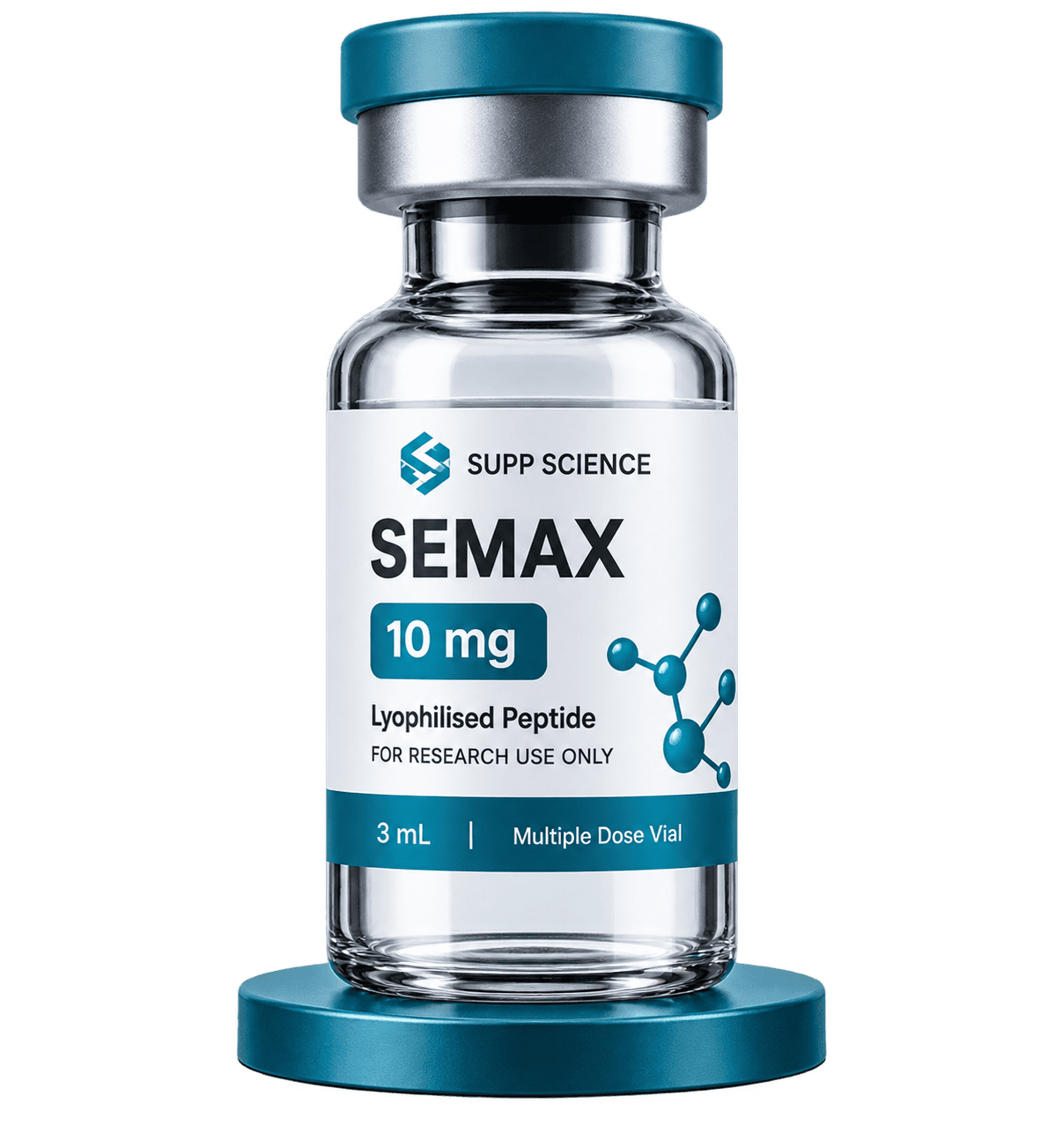
SEMAX — QUICK SUMMARY
What is Semax?
Semax is a synthetic seven-amino-acid peptide derived from a short fragment of adrenocorticotropic hormone (ACTH). Unlike ACTH itself, Semax is primarily studied for its effects involving the brain rather than for stimulating adrenal hormone production.
It was developed and studied extensively in Russia, where researchers investigated its effects on attention, cognitive performance and recovery after reduced blood flow to the brain during ischemic stroke.
One of the main areas of interest is neuroplasticity — the brain’s ability to adapt, form and strengthen connections and respond to learning or injury. Semax has been studied for its influence on neurotrophic signalling, including pathways involving brain-derived neurotrophic factor (BDNF).

Most human clinical research on Semax is not about productivity or everyday cognitive enhancement. Much of the meaningful human research has investigated neurological conditions such as ischemic stroke and recovery.
Community Discussion
See what the Supp Science community is discussing about Semax.
Semax discussions are on the way
Community threads and discussions about Semax will appear here as they are added to Supp Science.
Independent Testing
Independent laboratory results for Semax commissioned by Supp Science.
No independent tests yet
We don't currently have an independent laboratory result for Semax commissioned by Supp Science. You can request testing and we'll consider it for a future testing round.
Real Experiences
See how Semax performs in the real world, through the experiences of people who have actually used it.
Take Part in a Supp Science Review
Apply to take part in a structured product review. Selected participants receive the product free, with their experience and results documented from start to finish.
Community Experiences
Search real experiences in people's own words.
These are individual user reports collected from third-party sources. They are presented as experiences rather than proof of cause and effect. Use the original-source link to read the surrounding discussion and context.
Semax Research & Evidence
What human research tells us about the areas people are most interested in when looking at Semax.
Cognitive Performance
Semax is widely discussed today for focus and cognition, but direct human research in healthy people is relatively limited.
Early human research using intranasal doses of 0.25–1.0 mg reported improvements in operator work efficiency, with effects reported to last around 20–24 hours.
The finding is interesting, but the evidence base is much smaller and older than the research behind established cognitive medicines.
Brain Activity & Connectivity
Modern brain-imaging research shows that Semax can produce measurable changes in the brains of healthy people.
In a placebo-controlled study involving 24 healthy adults, brain scans taken 5 and 20 minutes after intranasal Semax found changes in the medial-frontal part of the brain's default-mode network.
A later study involving 52 healthy participants also reported changes in functional connectivity involving the amygdala and temporal regions.
These findings show that Semax affects brain activity, but changed connectivity does not automatically mean better memory or focus.
Stroke & Neurological Recovery
A significant part of the human Semax research involves people recovering from ischemic stroke rather than healthy people seeking cognitive enhancement.
One controlled study treated 30 people with acute ischemic stroke using Semax alongside intensive therapy and compared them with 80 people receiving conventional treatment.
Researchers reported faster recovery of some neurological functions, particularly motor impairment, in the Semax group.
Another rehabilitation study involving 110 stroke patients found higher BDNF levels alongside improvements in functional recovery measures.
BDNF & Neuroplasticity
BDNF is a protein involved in supporting neurons and helping the brain adapt, strengthen connections and respond to learning or injury.
In the 110-person stroke rehabilitation study, Semax increased plasma BDNF and the higher BDNF levels were associated with better improvements in everyday independence and motor recovery.
This supports BDNF as a genuine area of Semax research, but it does not mean that increasing BDNF automatically improves cognition in healthy people.
Human studies show that Semax can affect brain activity and has been investigated clinically for neurological recovery. Evidence for everyday cognitive enhancement in healthy people is much more limited, and much of the clinical literature originates from Russia.
Semax Questions & Answers
There is some human evidence that Semax affects brain networks involved in executive function, and older research reported improvements in work performance.
However, strong modern clinical trials showing better everyday focus in healthy people are lacking. Real-world experiences also vary considerably, from strong improvements in focus to little or no noticeable effect.
It can produce measurable changes relatively quickly. Human brain-imaging research detected changes in brain activity within 5–20 minutes of intranasal administration.
That does not mean everyone will immediately feel a cognitive effect. Real-world reports range from noticeable first-dose effects to benefits appearing over several days, while some people report no noticeable effect at all.
No. Semax is not a conventional stimulant like caffeine or amphetamine-based medications.
Some people describe increased alertness, drive or stimulation, but Semax is primarily studied for effects involving brain signalling and neurotrophic pathways rather than conventional central nervous system stimulation.
BDNF is a protein involved in maintaining neurons and helping the brain form, strengthen and adapt neural connections.
In a human rehabilitation study involving 110 stroke patients, Semax increased plasma BDNF and higher levels were associated with better functional recovery.
That supports BDNF as part of Semax's research story, but it does not prove that increasing BDNF improves cognition in healthy people.
No. Semax has been studied in humans, including research into cognition, brain activity and recovery following ischemic stroke.
The limitation is that much of the human evidence is relatively small, older and concentrated in Russian or post-Soviet research. Many of the detailed explanations of how Semax works still come from animal and laboratory studies.
No. Semax is not TGA-approved in Australia and is not FDA-approved in the United States.
Semax has an established history of medical use and research in Russia, but that should not be confused with regulatory approval in Australia or the United States.
Ask the Supp Science Team
Can't find what you're looking for? Send us your question and we'll look into it.
Medical Literature
Published human research on Semax, with the key findings summarised in plain English.
Semax during rehabilitation after ischemic stroke
Researchers studied 110 people recovering from ischemic stroke, with an average age of about 58 years. Semax was given in two 10-day courses at 6 mg/day.
Semax increased plasma BDNF, and higher BDNF levels were associated with better improvements in everyday independence and motor recovery.
View Study →Semax and the brain's default-mode network
Researchers studied 24 healthy adults. Fourteen received intranasal Semax and 10 received placebo, with brain scans performed before treatment and 5 and 20 minutes afterward.
The Semax group showed measurable changes in the medial-frontal component of the default-mode network. The study demonstrated an acute brain effect, but did not establish that those changes improved everyday cognition.
View Study →Semax and cognitive work performance
Early human research tested intranasal Semax at doses of 0.25–1.0 mg and reported beneficial effects on operator work efficiency lasting approximately 20–24 hours.
This study is particularly relevant because it looked directly at cognitive performance rather than neurological rehabilitation, although it comes from an older and much smaller evidence base.
View Study →Semax has published human research, but much of the clinical literature originates from Russia and includes relatively small or older studies. Findings should be interpreted in the context of the population studied rather than assumed to apply to healthy users seeking cognitive enhancement.
Help build better real-world evidence
Supp Science grows through independent testing, community discussion and the questions people actually want answered.
Test the Product
Request independent laboratory testing for Semax.
Request Testing →Join the Forum
Discuss Semax and the evidence with the Supp Science community.
Join the Forum →Ask a Question
Can't find what you're looking for? Send us your question.
Ask a Question →